Baby-Led Weaning: A Practical Starting Guide
Baby-led weaning means skipping purees and offering a baby soft, appropriately sized whole foods to pick up and feed themselves from the start of solids. It’s not about being hands-off with safety, it’s a different feeding method with its own rules about food size, texture, and timing.
This guide skips the deep science (Solid Starts covers that exhaustively, and cites the actual research) and focuses on what a parent needs the week they start: what gear is worth having, which first foods to reach for, and what’s normal versus what to actually worry about.
This guide is compiled from independent research, not hands-on testing. We are not currently part of any affiliate program, and this post contains no affiliate links.
The short answer
Baby-led weaning typically starts around 6 months, once a baby can sit upright with minimal support and has lost the tongue-thrust reflex that pushes solid food back out. Readiness matters more than an exact age — a baby who can’t yet sit stable in a high chair isn’t ready even at 6 months, while a baby showing strong interest in food and good head control usually is. Starting with soft, finger-length pieces cut to a safe size matters more than which specific first food you choose.
When to Actually Start
The American Academy of Pediatrics‘ readiness signal is behavioral, not calendar-based: a baby can sit up with minimal support, has good head control, and reaches for and brings objects to their mouth. For most babies that lines up with around 6 months old, but it’s the behavior that matters, not the date on the calendar.
Multiple studies on choking risk have found no meaningful difference between babies started on purees and babies started on age-appropriate finger foods. If safety is the thing holding a parent back from trying baby-led weaning specifically, that worry is aimed at the wrong target, food size and preparation matter far more than which method is used.
A few concrete signs to check for before the first meal:
- Sits upright in a high chair with little or no support
- Has lost the tongue-thrust reflex that pushes solid objects back out of the mouth
- Can pick up an object and bring it to their mouth on their own
- Shows real interest in food, reaching or leaning toward what’s on someone else’s plate
All four, not just the calendar date, are what actually signal readiness. A baby who hits these around 5.5 months is ready; a baby who’s technically 6 months old but still needs support to sit isn’t, yet.
What You Actually Need to Get Started
Almost nothing on the market is required. A high chair with a full tray, a bib that catches food rather than just crumbs, and a splash mat under the chair cover the actual mess. Skip the pre-loaded utensil sets and food-shaped silicone gadgets marketed specifically for baby-led weaning, a baby this age is using their whole hand, not a fork.
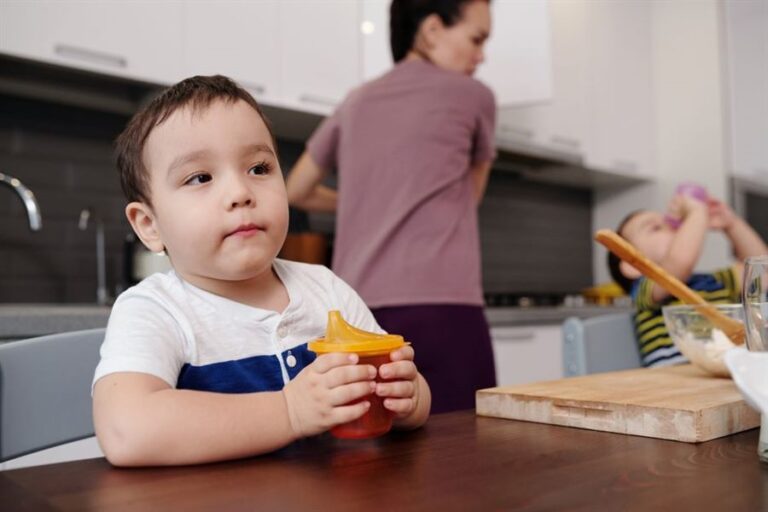
The one piece of gear worth actually choosing carefully is the cup. Water alongside meals starts around the same age as solids, and a cup that leaks constantly turns every meal into a bigger cleanup than the food itself. We cover what actually holds up in our guide to the best straw cups for toddlers.
First Foods That Work
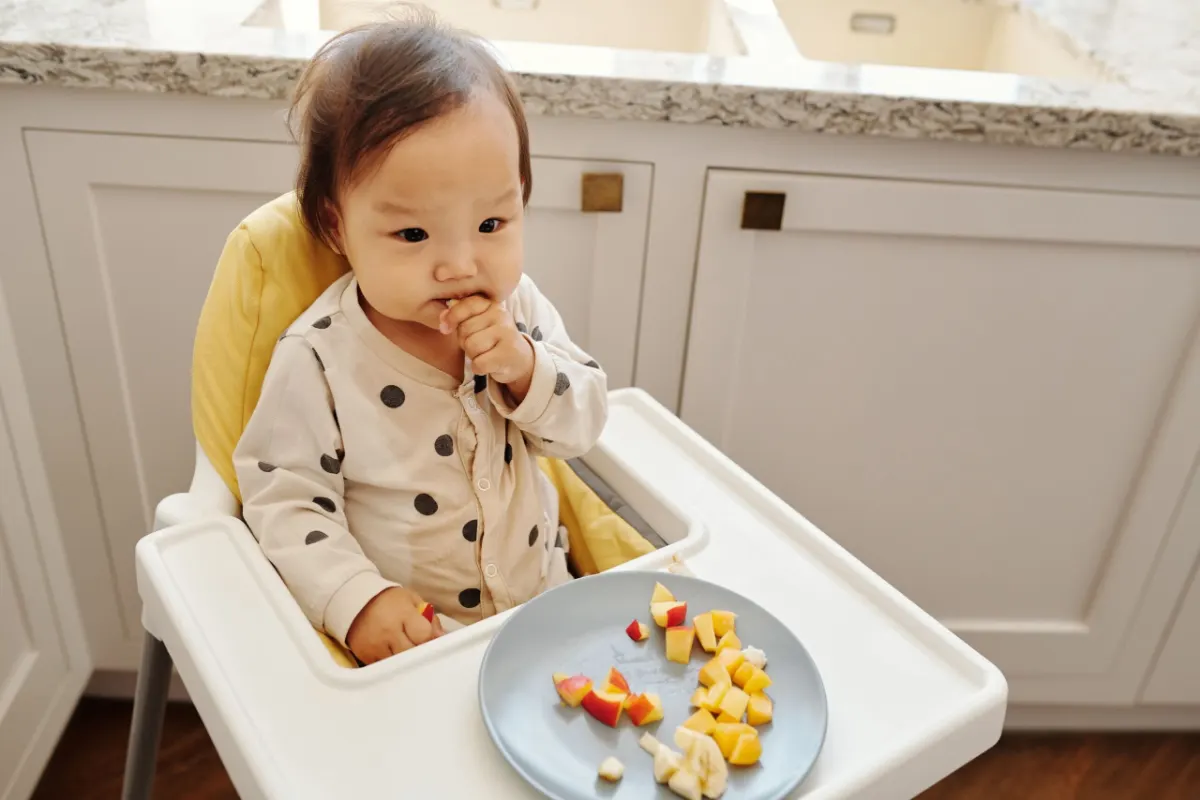
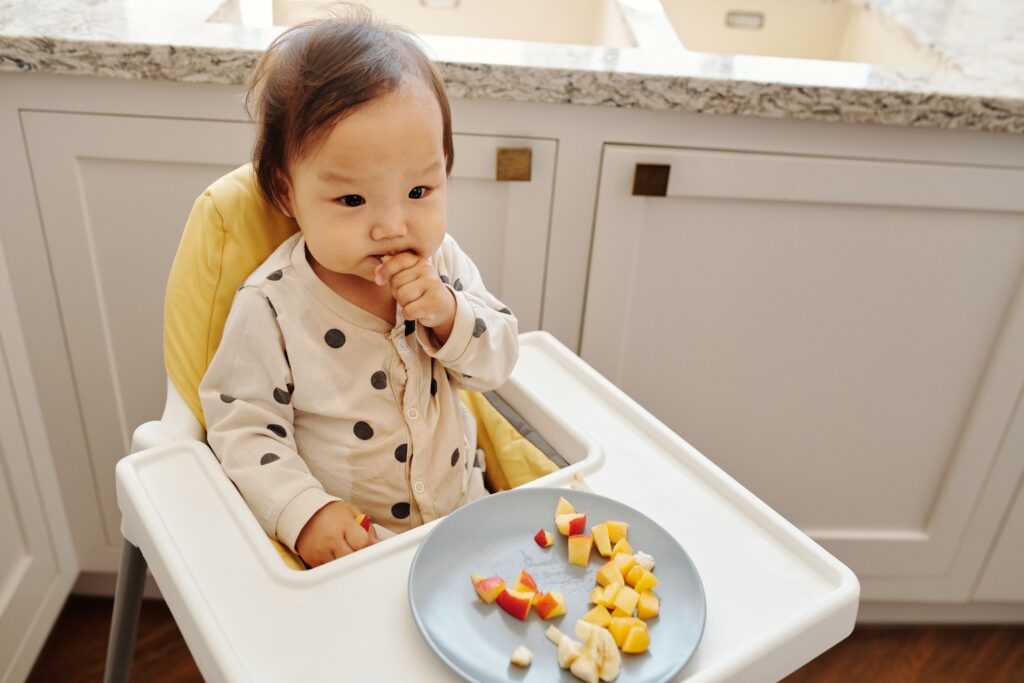
The general shape rule for a first week: pieces should be roughly the length of an adult finger, soft enough to smush between two fingers, and not round or hard enough to fully plug a small airway. A few that consistently work as true first foods:
- Steamed sweet potato wedges, skin left on for grip
- Ripe avocado, cut into thick spears
- Steamed broccoli florets, cooked past tender into soft
- Banana, left partly in the peel as a built-in handle
- Slow-cooked scrambled egg strips
- Toast strips with a thin layer of smooth nut butter (thin, not a thick glob)
How to Cut and Prepare Food Safely
The cut matters more than the food itself. The same fruit can be a good first food or a choking hazard depending entirely on its shape, and this is the step most new parents rush.
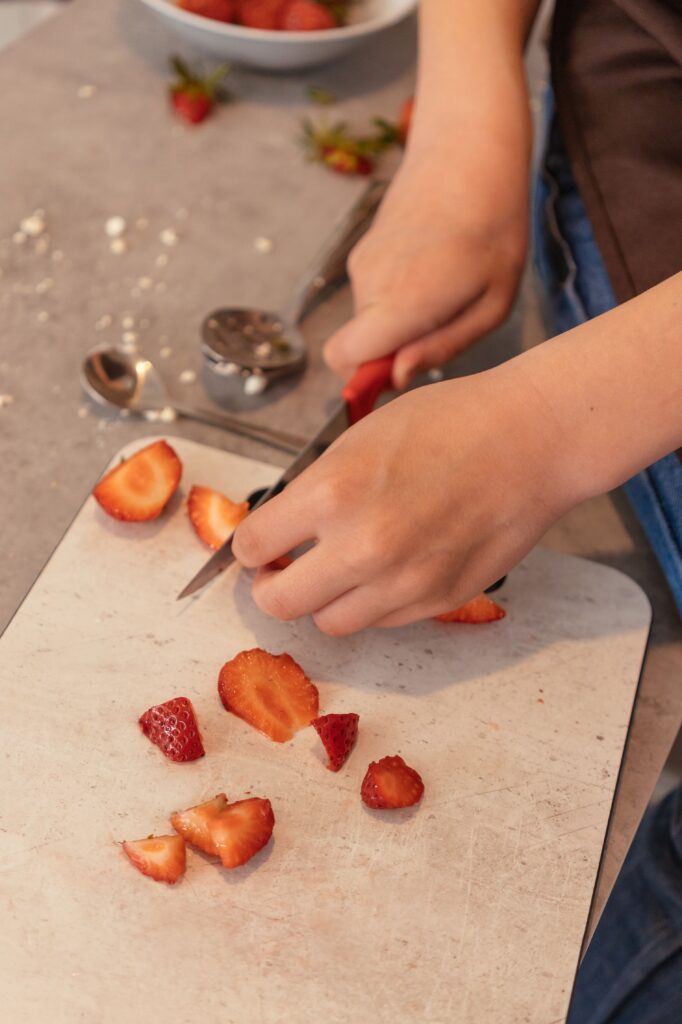
Round, firm foods are the highest-risk category, and the fix is almost always the same: cut round into long. Grapes, cherry tomatoes, and blueberries should be quartered lengthwise, never left whole or halved into circles, since a halved grape is still round enough to seal an airway. Hot dogs and sausages need the same lengthwise treatment, cut into thin strips rather than coins.
Hard raw vegetables like carrots and celery aren’t appropriate for early solids at all, they need to be steamed or roasted until they yield easily to light pressure between two fingers, the same test used for the finger foods listed above. Nuts, seeds, popcorn, and hard candies should be avoided entirely until well past the toddler years, they’re small, hard, and dense in exactly the shape that blocks an airway.
Choking Safety Basics
Gagging is loud, active, and normal, it’s the body pushing food forward and out. Choking is silent or produces a weak, ineffective cough, with the airway actually blocked. Confusing the two is the single biggest reason parents intervene when they shouldn’t, or don’t act when they should.
| Sign | Gagging (Normal) | Choking (Emergency) |
|---|---|---|
| Sound | Loud coughing, gulping, retching | Silent, or a weak, high-pitched wheeze |
| What’s Happening | Airway reflex pushing food back out on its own | Airway may be partly or fully blocked |
| Face & Color | May turn red, eyes water, still breathing | May turn blue or very pale |
| What to Do | Stay calm and let the reflex work, don’t intervene | Act immediately with infant/child choking first aid |
What to Expect the First Week
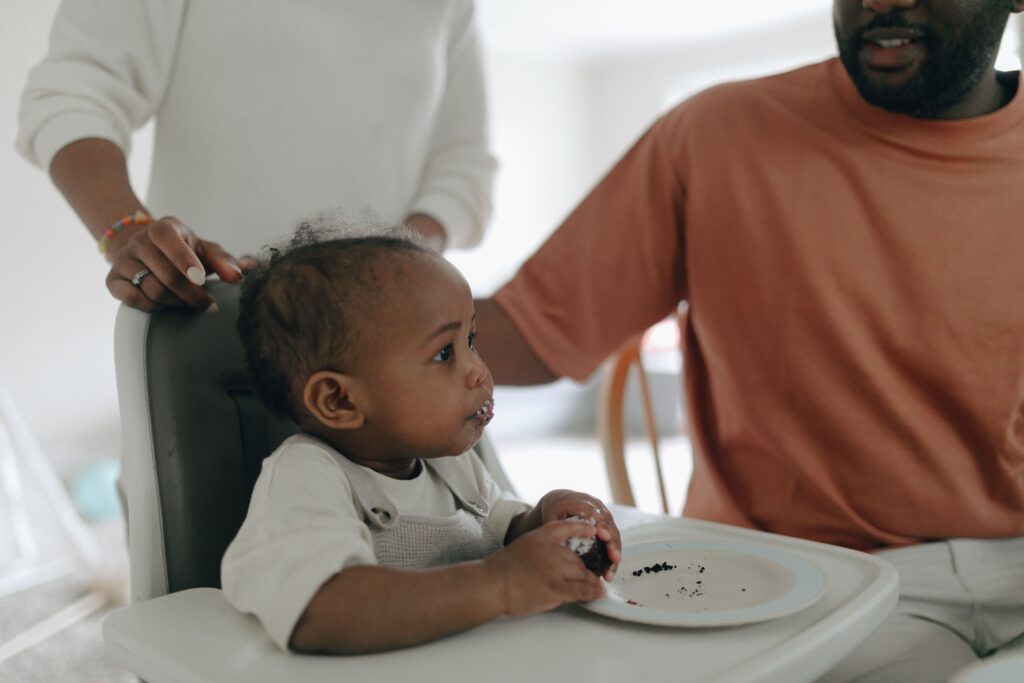
Most of the food ends up on the floor, the tray, or in a fist, not in the mouth, and that’s normal for the first couple of weeks. Breast milk or formula is still doing the actual nutritional work at this stage. Solids before 12 months are about practicing the skill of eating, not about calories or a full plate.
Gagging will happen, probably daily, and it looks more alarming than it is. It’s worth watching a short video of normal infant gagging once, before the first meal, so the sound and the face are familiar and don’t trigger a panicked reaction the first time they happen live.
A bib that covers the arms, a splash mat, and lowered expectations for how clean the kitchen floor stays are the real preparation for week one, more than any specific product.
A Simple First Meal to Try
For a first sitting, keep it to two or three items so it’s easy to see what a baby actually engages with. A steamed sweet potato wedge, a spear of ripe avocado, and a strip of slow-cooked scrambled egg cover three different textures, three different nutrient profiles, and none of them require a special trip to a specialty grocery store.
Offer the food, sit down at the same level as the high chair, and resist the urge to guide the baby’s hand to their mouth. The whole point of the method is that the baby is doing the picking up, the exploring, and the deciding, an adult’s job at the table is supervision, not assistance, unless something goes wrong.
Expect the first sitting to last five to ten minutes before interest drops off. That’s a normal attention span for a baby this age, not a sign the food or the method isn’t working.
Common Mistakes to Avoid
A few errors come up often enough to call out directly:
- Serving round foods whole or halved. Grapes, cherry tomatoes, and blueberries need to be quartered, not just cut in half.
- Adding honey before 12 months. Honey carries a real risk of infant botulism in babies under one year and should be avoided completely until then.
- Skipping iron-rich foods. A baby’s iron stores from birth start dropping around 6 months, so foods like slow-cooked meat strips, iron-fortified cereal, or well-cooked egg matter early on, not just fruit and vegetables.
- Walking away during meals. Baby-led weaning still requires a seated adult within arm’s reach for the entire meal, every time.
- Cutting food too small too soon. Pieces that are too small can be harder to grasp and more likely to be swallowed before they’re gummed down, the finger-length rule exists for a reason.
Frequently Asked Questions
Does baby-led weaning increase the risk of choking compared to purees?
Research comparing the two methods has not found a meaningful difference in choking risk. What matters far more than the method is food size and preparation, appropriately cut, soft, age-suitable pieces are the actual safety factor, not whether purees were used first.
Does my baby need teeth to start baby-led weaning?
No. Babies gum food effectively using their jaws and gums well before teeth come in, and most of the early chewing work happens without any teeth at all. Soft, well-cooked textures matter more than tooth count.
How messy is baby-led weaning really?
Messier than spoon-feeding purees, especially in the first few weeks when most food ends up outside the mouth. A splash mat under the high chair and a full-coverage bib handle most of it, and the mess tends to drop off noticeably once a baby’s aim improves around 8 to 9 months.
Can I combine baby-led weaning with purees?
Yes. Many families offer finger foods at some meals and spoon-fed purees at others, sometimes called a combination approach. There’s no research showing this is worse than either method used exclusively, so it’s a reasonable option if a full switch to finger foods feels like too much at once.
What if my baby refuses everything at first?
Repeated, low-pressure exposure works better than pushing a food harder. Research on food acceptance in babies and toddlers generally points to somewhere between eight and fifteen exposures before a new food is accepted, so a single refused meal isn’t a verdict on that food, it’s just exposure number one. Keep offering the same rejected food alongside something already familiar rather than swapping it out entirely.
Once mealtime gear enters the picture, our baby bowl guide covers what actually stays on the tray.
If dairy is one of the foods you’re avoiding during this stage, our dairy-free toddler meal ideas carries the same finger-food approach into dairy-free territory once your baby moves past first foods.
About the Author: Emma Carter
Emma Carter writes and edits every guide on 3 Things for Mom. She researches each recommendation through manufacturer specs, safety certifications, and patterns across real customer reviews before it makes the list. More on how picks are made →
(Illustrated avatar, not a photograph.)